A pipe router that says why it can't
SD-DC is a toolkit for designing data centres with AI agents doing the legwork: cable sizing to AS/NZS 3008, tray routing, parametric FreeCAD geometry, hall thermals. This week it gained a pipe router, a cable tray router built on top of it, and a page that explains the whole thing.
The old router broke the rules it was meant to follow
There were already three routers in the repo. All of them searched a grid, cell by cell, and then patched the result to look like pipework. That is the wrong way round. A pipe isn't a path through cells. It's a set of straight runs joined by elbows, and an elbow needs room. Searching cells produced routes that turned straight out of a nozzle, put two elbows too close together to fabricate, doubled back on themselves, or nudged an endpoint a few millimetres to make the maths work.
The new one, piping/core/router.py,
searches over corners instead of cells. A state is a corner plus the
direction the pipe was travelling when it got there. A move is a whole
straight run to the next corner. Because of that, the rules aren't checks
bolted on at the end. They're part of what a move is:
- the first run leaves the outlet along its outward direction, and the last run arrives head-on into the inlet. Endpoints are never snapped
- a run next to a nozzle is at least one bend radius long, and a run between two elbows at least two
- every turn is 90°, never 180°
- no run comes within pipe radius plus clearance of an obstacle
Here is the second rule in code. need is the shortest run that leaves
room for the elbows at both ends, and any corner closer than that is never
offered as a stop:
reach, _ = fld.reach(p, d, first=is_start)
need = br if is_start else 2 * br
if reach + EPS < need:
    continue
line = coords[ax]
if s > 0:
    stops = line[bisect.bisect_left(line, p[ax] + need - EPS):
                 bisect.bisect_right(line, p[ax] + reach + EPS)]
Cost is length plus a fixed cost per elbow, so given two routes the router picks the one with fewer elbows unless the other is a lot shorter. That's also how a pipefitter would choose.
Tested against a real design
The benchmark is a real chilled-water layout: 34 pipes, each routed by hand by an engineer. The router finds all 34, one at a time and as a single batch. None of its routes is longer than the hand route or has more elbows, and the total comes to 194.2 m against 196.4 m. That benchmark includes only the obstacles the build script places. The chillers, fan walls and building shell come next, and they will make it harder.
The design data itself stays out of the public repo. The engines, schemas and tests are open, and project data is gitignored. That split runs through all of SD-DC.
A failed route is an answer too
The part I care about most is what happens when there is no route. An agent
asked to route a pipe that can't be built needs to know why, so it can
move something and try again. The router doesn't return None. It returns
one of blocked_nozzle, enclosed_inlet, enclosed_outlet, no_path
or no_path_within_budget, along with the obstacle in the way, how short
the gap is, and a suggested fix
(_blocked). Two scenarios from
the old routing report that looked like bugs turned out to be impossible
routes. They're now encoded as tests that expect a refusal.
Served the way the cable sizer is
piping/service.py puts the router behind MCP
(stdio and HTTP) and REST, the same way the cable-sizing engine is served:
piping_route_pipe, piping_route_network, piping_validate_route,
piping_list_specs. A routed pipe comes back with its straights and
elbows, a bill of materials, the validator's verdict, and an IndustroML
connection that validates against the v1 schema. A second tool,
piping_render_routes, draws review sheets (plan, two elevations and an
isometric) with rule breaks in red and unrouted pipes dashed. Those
sheets are for a person to look over before anything is ordered.
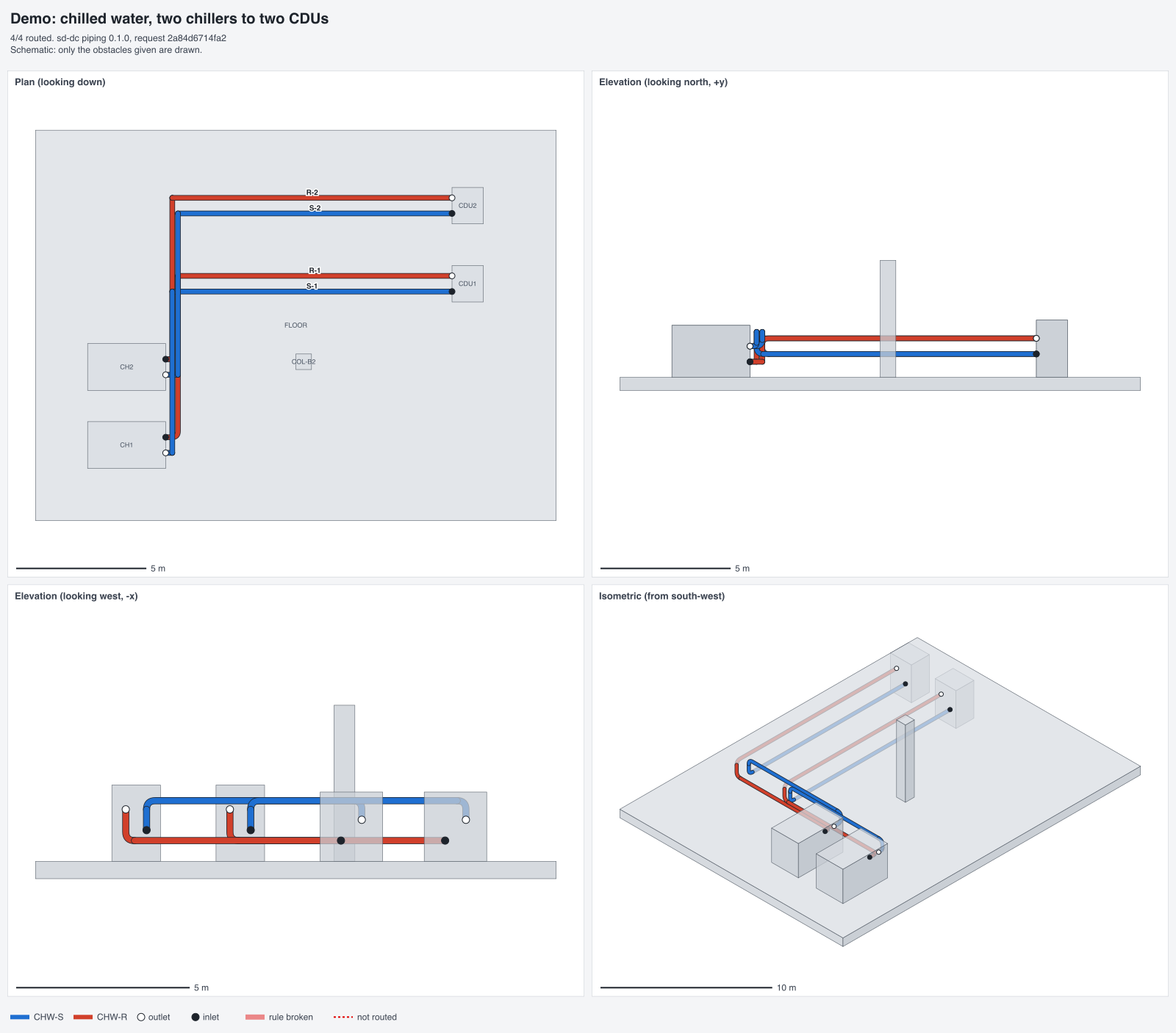
piping_render_routes: four chilled-water pipes, two chillers to two CDUs. The scene is invented.Trays reuse the same router
Cable trays are routed by the same engine. The difference is that a flat
tray gets its real clearance above and below, not half its width, because
obstacles are now grown by the body's envelope in each run direction.
trays/tray.py then supports the tray off the ground:
span from the load table, supports near fittings, splices landing beside
supports, cantilever or goalpost by width and load, and posts slid along
the run when they clash.
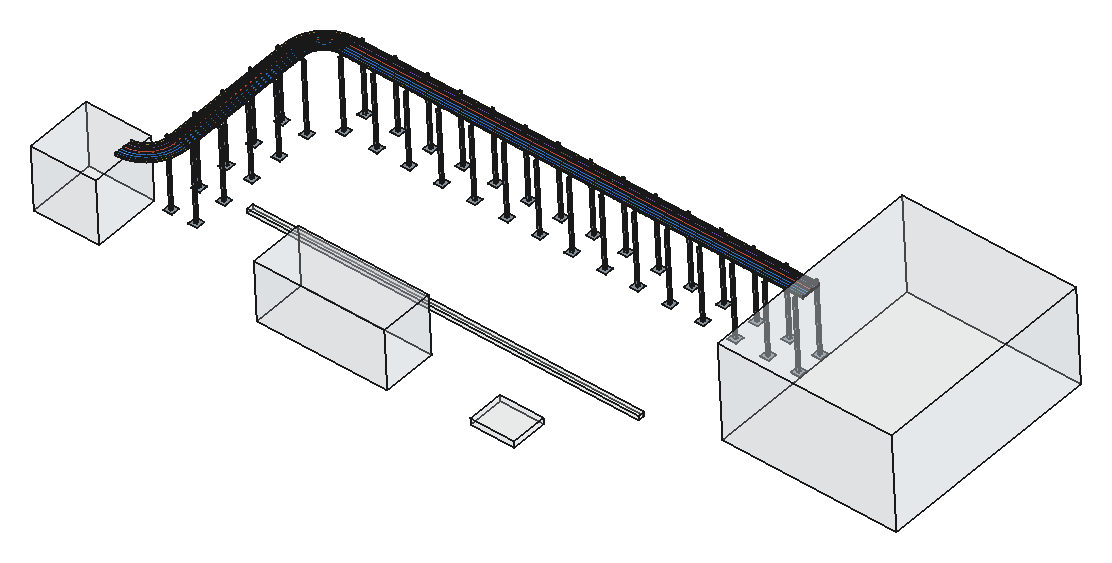
trays/cables.py sizes every circuit on the
tray with the AS/NZS 3008 engine, grouping all the runs together, and feeds
the cable mass back into the support span. Then
trays/freecad_build.py builds the tray,
supports and every core as a FreeCAD model and exports STEP. Cable
schedule out as CSV.
What's next
The obstacles the benchmark doesn't have yet (chillers, fan walls, the
building) and a CAD host so other agents can ask for geometry rather than
just centrelines. The code is MIT on
GitHub, with 39 routing tests run by
run-tests.sh.