usbnet: flashing an ESP32 and an Uno on a Raspberry Pi from a Mac
usbnet puts USB devices plugged into a
Raspberry Pi within reach of my Mac. The first target was serial boards: an
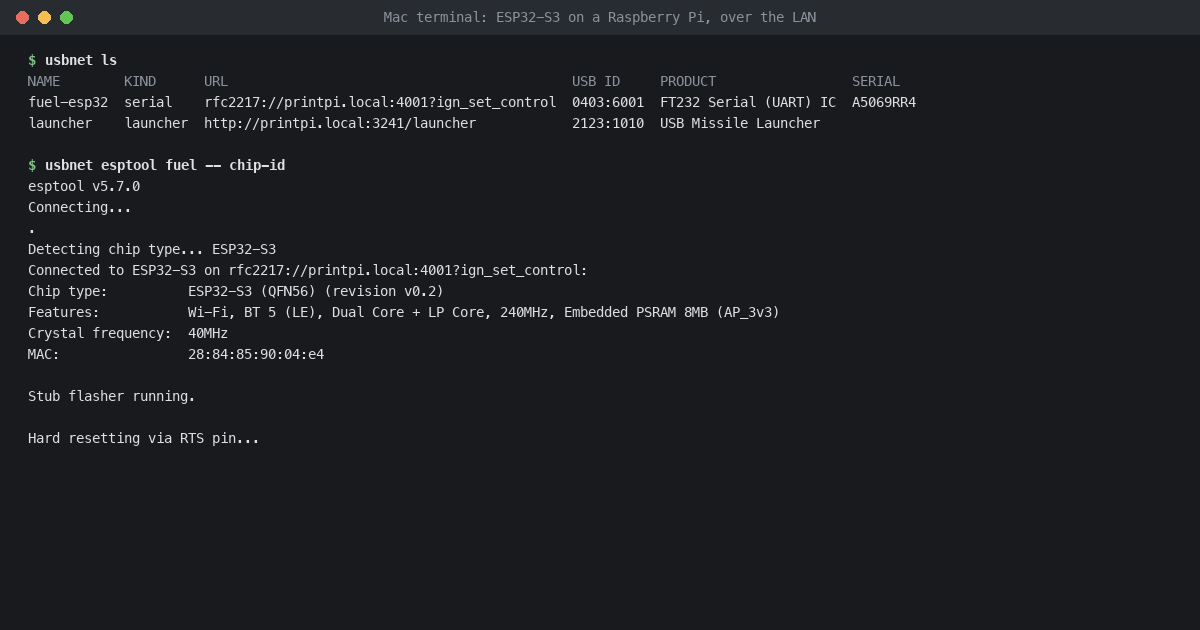
ESP32-S3 on the Pi's hub shows up on the Mac as
rfc2217://printpi.local:4001, and esptool connects to it, identifies the
chip and runs its flasher stub across the LAN. It is about 1,000 lines of
Python and shell, MIT licensed, with 19 tests. Everything below was run on
28 November 2026 against a Pi 4 on wired Ethernet and a Mac on the same LAN.
Why not USB/IP on the Mac
Linux has USB/IP: the Pi exports a device, a client attaches it, and it appears as local USB. macOS has no USB/IP client. Making a remote device look local needs a virtual USB host controller inside macOS. Kernel extensions used to do that and are now deprecated. VirtualHere's client logs "Unable to connect to the kernel" when it tries Apple's user-space API for this. Parallels and UTM only go the other way: they take a device that is physically on the Mac and hand its traffic to a VM.
So usbnet works per device class instead, and translates each class into something macOS already understands. Serial goes over RFC2217, which is telnet plus COM-PORT-OPTION, so the remote end can set baud and drive DTR and RTS. pyserial speaks it, and so does anything built on pyserial, including esptool. A Linux machine can still use USB/IP for everything else.
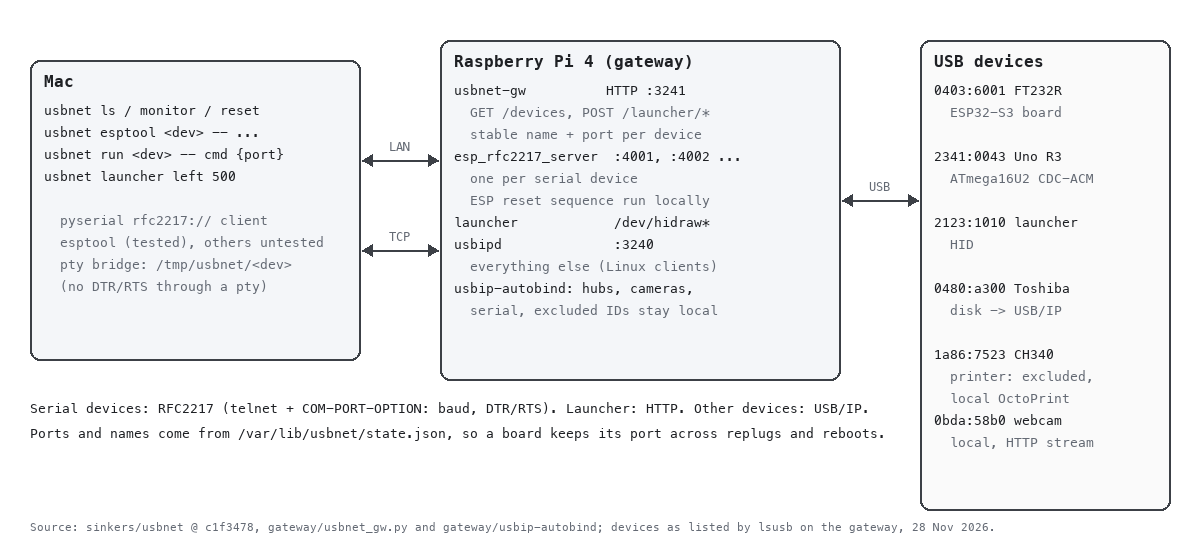
lsusb on the Pi; ports
and code from usbnet_gw.py at c1f3478.How it works
On the Pi, usbnet-gw polls /sys/class/tty every 2 s for ttyUSB* and
ttyACM*. It gives each device a name, made from the chip plus the USB
serial number (or the port path when the chip has no serial number), and a
TCP port from 4001 upwards. Both are kept in /var/lib/usbnet/state.json,
so a board gets the same port after a replug or a reboot. The daemon runs one
esp_rfc2217_server per device and lists them all on GET :3241/devices. A
udev hook shares any other device over USB/IP, except hubs, cameras, serial
devices and anything in /etc/usbnet/exclude. The 3D printer's CH340 is in
that list, because OctoPrint on the same Pi drives it.
On the Mac:
uv tool install --with esptool git+https://github.com/sinkers/usbnet
usbnet ls
usbnet esptool fuel -- chip-id          # --port filled in from the gateway
usbnet esptool fuel -- read-flash 0 0x40000 dump.bin
usbnet reset fuel                       # pulse EN to see the boot log
usbnet run arduino -- arduino-cli upload -p {port} -b arduino:avr:uno Blink
usbnet launcher left 500
What I checked
| Test, macOS client | Result |
|---|---|
esptool chip-id (esptool 5.7.0) |
ESP32-S3 (QFN56) rev v0.2, MAC 28:84:85:90:04:e4, stub running |
read-flash 256 KB at 115200 |
23.5 s, 89.4 kbit/s, digest OK |
read-flash 256 KB at 460800 |
11.1 s, 188.7 kbit/s, digest OK, byte-identical to the 115200 read |
read-flash at 921600 |
1 MB: "Digest mismatch". 256 KB: "Read more than expected" |
pyserial read after usbnet reset |
482 bytes of boot log and firmware output |
Uno R3, arduino-cli upload (2.2 KB sketch) |
3/3 in 6.0 to 7.7 s; new sketch's banner read back over serial |
| Uno R3, avrdude 6.3 write + verify | 5594 bytes written and verified in 5.4 s |
arduino-cli monitor via pty |
fails: "error getting modem bits status" |
I didn't write to the ESP32, which belongs to another project. The Uno's flash was backed up first (read on the Pi, then verified against the chip), and the avrdude row is that backup going back on.
What was wrong along the way
The first version served each port with ser2net. Reads worked, but esptool
failed every time with "Wrong boot mode detected (0x8)". Getting an ESP32
into its bootloader takes a DTR/RTS sequence timed to tens of milliseconds,
and a LAN round trip between each step throws the timing off. Espressif ships
esp_rfc2217_server for exactly this case. It spots the start of the reset
sequence and runs the whole thing on the Pi. With that server, esptool
connected on its first attempt. The cost is a Python process per device
instead of one ser2net.
Smaller mistakes:
- ser2net rejected the generated config when no devices were plugged in ("Unexpected scalar value"), because a YAML document with no entries is null.
- The names file cut "Fuel ESP32" down to "fuel".
- During an upgrade, the old daemon was still running. It saw its config disappear, rewrote it, and restarted ser2net, which then grabbed port 4001.
uv tool installkept serving a cached 0.1.0 wheel until I bumped the version.- Restoring the Uno's full 32 KB dump failed at 0x7E80: it includes the Optiboot bootloader, which won't overwrite itself. The sketch region alone restores.
Uno uploads took several attempts. avrdude resets the board by toggling DTR,
which a pty can't carry, so usbnet run reconnects the RFC2217 session when
an uploader starts talking, and the gateway's server runs the reset. Holding
avrdude's sync and forwarding it once the bootloader was up still failed, one
reply out of step. A byte trace (USBNET_TRACE=1) showed why:
   2.858 -> 30 20 30 20
   2.861 <- 14 10 14 10
   2.861 -> 41 81 20
   2.865 <- 14
avrdude: stk500_getparm(): (a) protocol error, expect=0x14, resp=0x14
During the 1.7 s hold, avrdude had retried, and the pty had merged two syncs into one read. The board answered both, and avrdude had already drained past the first answer. The bridge now forwards only the latest write, collapsed to one copy. With that, the next three uploads all worked.
Limits
The obvious objection is that RFC2217 isn't USB. It isn't, and that shows up in the tools.
- The upload reset is a heuristic. It keys on "first write after 2 s of
quiet" and on the tool retrying its sync. avrdude and
arduino-cli uploaddo both. A tool that sends once and waits would need its reset done on the Pi instead. - A pty can't carry modem lines.
arduino-cli monitorand the Arduino IDE's serial monitor give up on it. Tools that take arfc2217://URL avoid the problem. - 921600 baud is unreliable. Use esptool's default of 460800.
- No authentication. Anyone who can reach ports 3241 or 4001 and up can reflash a board. Keep it on a trusted LAN or tailnet.
- Untested: PlatformIO,
idf.py, screen or minicom on the pty, and ESP32-S3 boards on native USB, which re-enumerate during reset. - Opening a session resets the board, as a local USB port usually does.
Next
Storage: the Pi will mount a USB drive and share it over SMB, with a
usbnet mount command on the Mac. The same day, the Pi also took over
OctoPrint and the printer camera from the home server. A USB missile launcher
turned up on the hub as well. It is driven through /dev/hidraw from
POST /launcher/<action>, and it moves.