Grid, BESS and UPS as drop-in components
The day after the pipe router, SD-DC got a power simulator. It answers questions about a site's point of connection: what a battery beside the UPS earns on a real price day, what a 150 ms voltage sag does to the UPS, and whether a standby generator survives the UPS recharging after an outage.
It is one commit,
c367ee7,
on the power-sim branch. It isn't merged to main yet and nothing has
been added since. Standard-library Python only, 146 tests.
A simulation is a model, not code
Each component lives in power-sim/model/dtpower/components/ and knows
nothing about any simulation. It declares an IndustroML asset kind, its
ports, a parameter schema (label, unit, range, default) and a role:
source, bus, conversion, storage, load, controller or
generator. The registry maps kind to class, so a new component is usable
by every simulation once it is listed
(components/__init__.py L31).
A simulation is then just a list of assets and the cables between them. This is the whole of simulation 01's wiring:
LINKS = [
    ("C-01", "cable", "UTIL.OUT", "MSB.IN"),
    ("C-02", "cable", "MSB.OUT", "BESS-1.AC"),
    ("C-03", "cable", "MSB.OUT", "UPS-1.IN"),
    ("C-04", "cable", "UPS-1.OUT", "GPU-1.IN"),
    ("D-01", "data_link", "DR-1.NET", "BESS-1.CTRL"),
    ("C-05", "cable", "GEN-1.OUT", "MSB.ALT"),
]
network.py
turns that into a tree and steps it. Loads report demand, the UPS turns
output demand into input demand (load, losses, recharge), and at each bus
the passive feeders are summed before the BESS controller decides, so the
controller knows what the site draws. Storage dispatches before the
generator, because stored energy costs wear and a running set costs fuel.
The grid takes whatever is left. A double feed, an unknown kind or an
asset with no supply is rejected with a reason. The viewer builds its
sliders from the same schemas, so adding a parameter to a component adds a
control.
The default site is 16 DGX H100s at 80 % utilisation (about 139 kW) behind a 250 kW UPS with 45 kWh of battery, a 200 kW / 400 kWh BESS on the same switchboard, and a 400 kW grid connection.
What a run shows
python3 -m dtpower scenarios bess-dr
python3 -m dtpower run bess-dr --scenario nsw-spike --set BESS-1.capacity_kwh=800
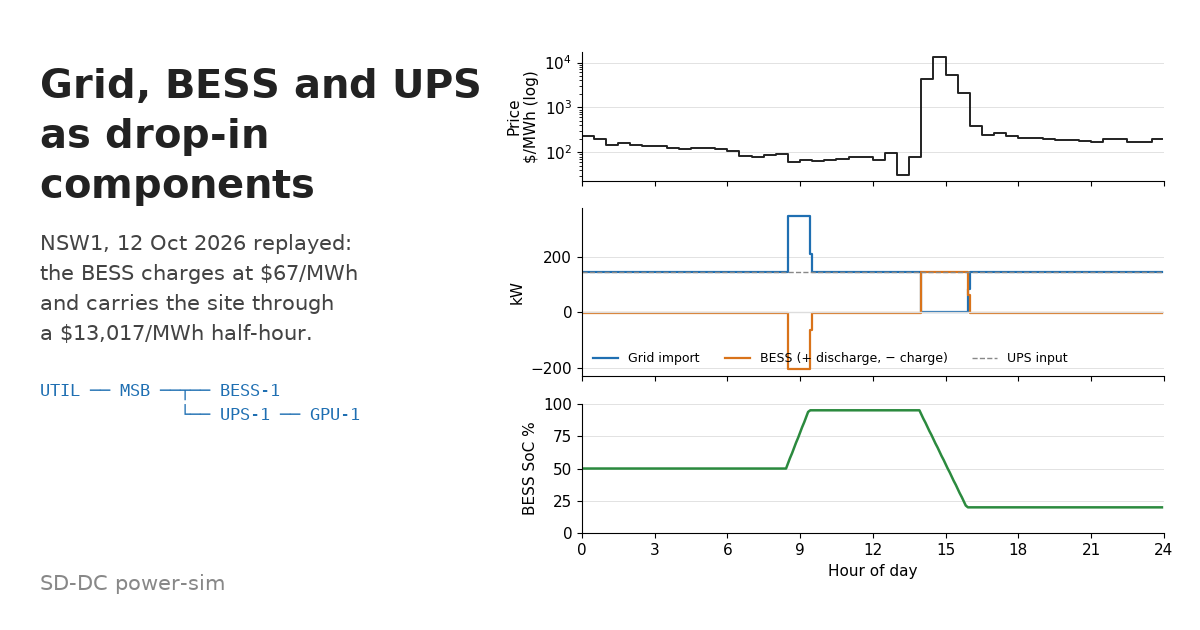
There are 19 scenarios. I ran all the ones quoted here at the commit. On AEMO prices for NSW1 on 12 October 2026, the price sat between about $30 and $230 until 14:00 and then passed $13,000/MWh. The BESS charges 185 kWh mid-morning at a mean $67/MWh and discharges 292 kWh at a mean $6,169/MWh, carrying the whole load while the spike lasts. The day's bill falls from $2,382 to $634. The saving comes out at $1,724.
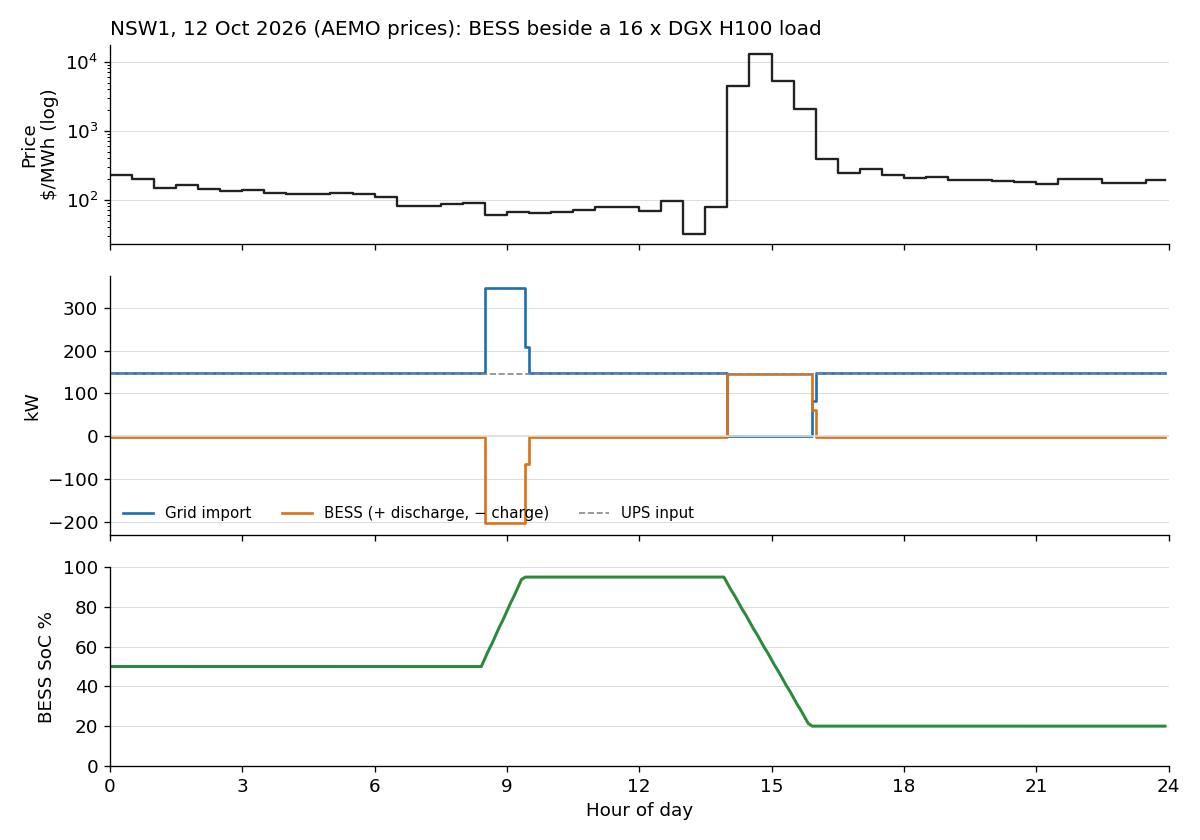
nsw-spike at default settings, plotted from dtpower run --rows.That saving isn't the bill difference. The day runs three times (no BESS,
BESS only, everything) and the saving is the baseline bill minus the bill,
minus battery wear, plus the change in stored energy valued at the day's
median price
(_saving).
Here the battery ends at 20 % having started at 50 %, which costs $17.
Without that term a strategy can look good just by finishing emptier
than it began.
The other cases put that number in context. A flat $100/MWh day loses $8: auxiliaries and losses with nothing to arbitrage. That's the control case. Capping the GPUs to 70 % above $300/MWh adds $39 and costs 3.1 server-hours of compute. Doubling the BESS to 800 kWh only lifts the spike day to $1,772. On a South Australian day of negative prices the BESS is paid to charge, at −$84/MWh on average, and the saving is $15. A generator started above $500/MWh, with no BESS, saves $1,567 after $172 of fuel.
Sags at two-second steps
Seven scenarios run 45 minutes at two-second steps around an event at 14:00. A sag is an event with a depth and a duration, so a 150 ms dip inside a two-second step still counts as 150 ms.
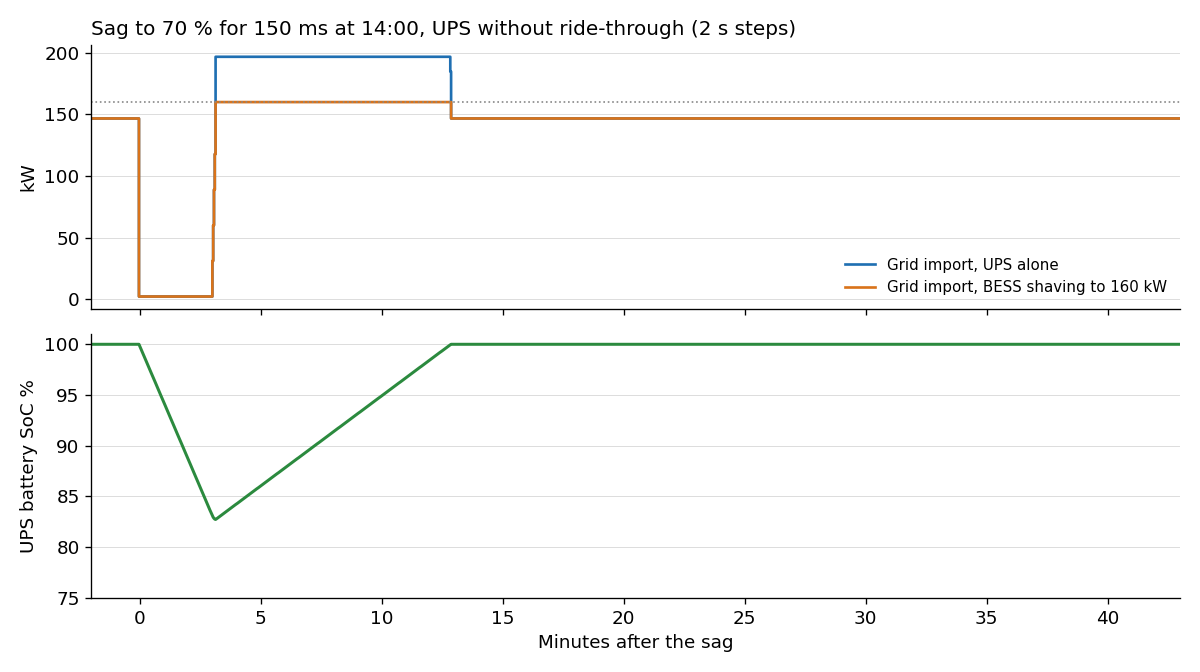
sag-no-ride-through and sag-bess-shave. The dotted line is the 160 kW limit.A sag to 70 % for 150 ms, with UPS ride-through off, puts the UPS on battery for 190 s through a three-minute resync, down to 83 %. Then the recharge lifts the UPS input to 194 kW, a new site peak. With ride-through on, the sag is inside the envelope and nothing happens. With the BESS peak-shaving, the UPS recharges at full rate and the grid never sees more than 160 kW. Four sags in seven minutes keep restarting the resync: 580 s on battery, down to 47 %.
A 25-minute outage with no generator outlasts the UPS. It rides for 17 minutes, then 20.8 kWh goes unserved. With the generator, the UPS recharge can trip it: a 35 % recharge on a 200 kW set trips it, unless the UPS max demand holds the recharge back.
What it doesn't model yet
- Nothing is verified. The UPS loss curve, GPU idle power, the
throughput-under-cap curve, $25/MWh battery wear, diesel burn and the
AS/NZS 4777.2 reconnect defaults are all marked
verified: falsewith their source. Vera Rubin NVL72 power is a supply-chain estimate. - Energy only. No demand charges, no reactive power, no cable losses. Everything is kW at unity power factor.
- Radial networks only. One source, no dual-path feeds.
- The BESS has no IndustroML kind. IndustroML has no
bess,batteryorinverter, so the BESS is flagged as a proposed kind and these models don't validate against the schema yet. - Recorded prices may sit one interval early. Whether AEMO labels an interval by its start or its end isn't confirmed.
- The "optimal" controller is near-optimal. It plans on a grid of SoC levels and can trail well-tuned thresholds by a few percent.
- One number is stale. The README at this commit gives 18.5 kWh unserved for the outage case. A run at the same commit gives 20.8.
Next
Simulation 02 swaps the BESS for a UPS whose rectifier is a bidirectional
converter, so one bigger battery does ride-through and arbitrage. The
question is whether that beats a separate BESS, and how much it must hold
back for an outage. Battery and Converter are already shared parts, so
the change is in the wiring, not the components. After that comes a
drag-and-drop editor and telemetry: Network already accepts measured
values per asset in place of modelled ones, but only the GPU load uses it.
The code is MIT on GitHub.